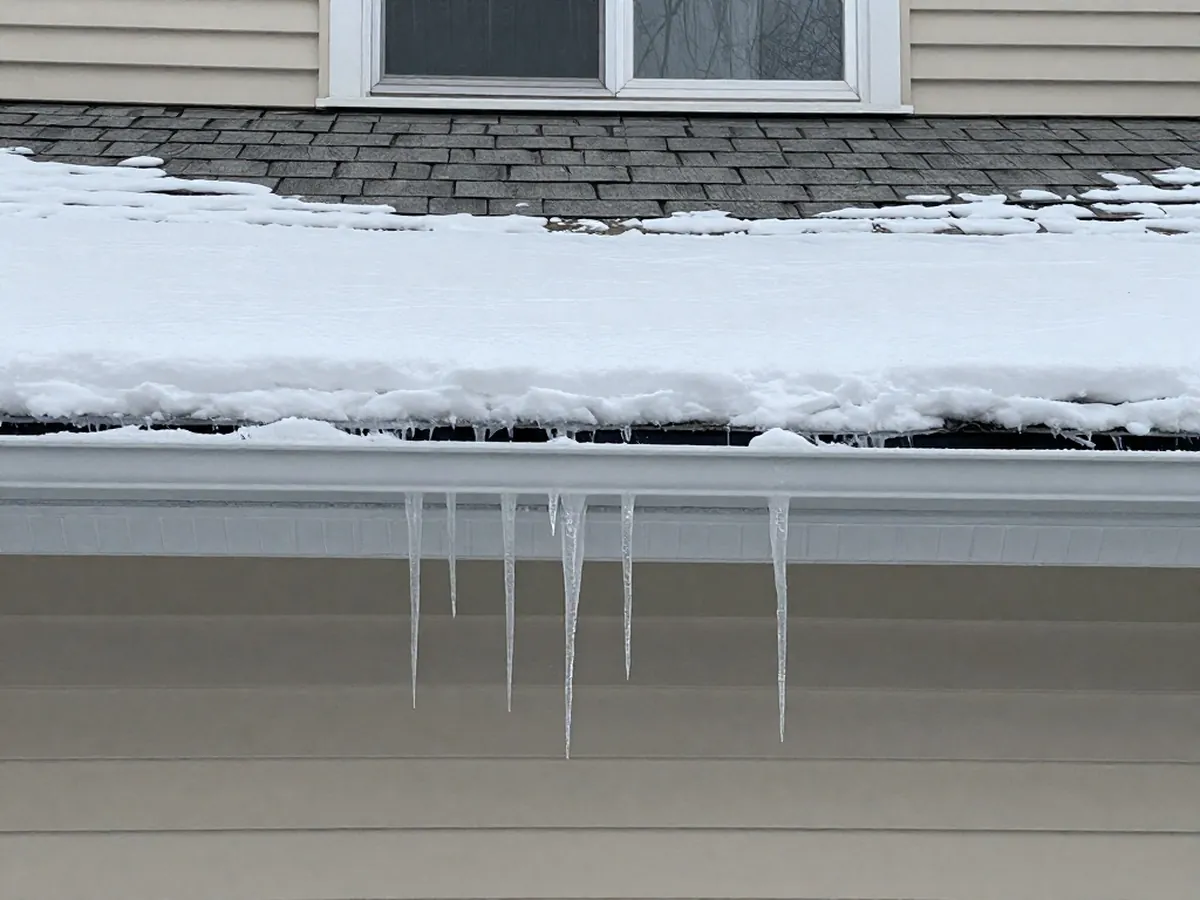
A thick ridge of ice at the eave, and water backing up behind it
Ice Dam Damage in Lincoln Park, NJ
Ice dams form at the eave when heat from the house melts the snow above it and the water refreezes at the cold edge. Your move: call (862) 972-4008 during the thaw, before water reaches the ceiling, and give your number out of ten.
Have this ready
Record the thaw
On a thaw day, photograph the eave from the yard and the stain indoors. Note the outdoor temperature, how much snow is on the roof and when the stain began. If the attic hatch is easy and safe to reach, a photo of the underside of the roof near the eaves adds a lot.
Then dial (862) 972-4008. The pattern over a few days says more than a single photo.
Repair or replace?
Remove the ice, or change what makes it?
UMass describes the dam as the visible end of a heat problem: snow, heat and cold have to coincide, and on a poorly insulated roof even 1 to 2 inches of snow can form one. Clearing ice treats the symptom. Air sealing, insulation and ventilation treat the cause, and those jobs sit in the attic as much as on the roof.
Heat tape and roof rakes both appear in the UMass piece with caveats: rakes can scrape off shingle granules, and hacking at ice is risky.
Stop here if you see any of this
- Large icicles or a slab of ice overhang an entry or the driveway: keep people and cars clear until it has come down.
- Water drips through a ceiling light or around an outlet: leave the room and phone 911 once you are standing somewhere dry.
- The ceiling beneath the eave bulges or sags: everyone leaves the room, and 911 is the call when it looks ready to come down.
- The only way to the ice is up a ladder or onto the roof: do not climb. UMass warns that hacking at ice is risky for the person and for the roof.
On the roof and in the attic
- Dial (862) 972-4008 during the thaw, give the address, where the stain shows and your number out of ten. Photos of the eave and the attic are useful.
- Outside, the roofer reads the ice line: how far up the roof it reaches, and whether it sits over a heated room.
- In the attic, the roofer looks for frost, wet insulation and daylight, and for places where warm air leaks up from the rooms below.
- Insulation depth and the vent path from eave to ridge get measured, or at least looked at.
- The quote separates the short-term job, removing ice and drying out, from the lasting one: air sealing, insulation, ventilation and membrane at the eaves.
- Ask whether the job changes the heat source. A dam cleared without that change tends to return.
The parts in play
Snow, heat and cold: the three ingredients
Take away any one and the dam does not form. Snow sits on the roof. Heat comes up from the house through air leaks and thin insulation, and melts the snow from underneath. The eave, outside the warm wall, stays cold, and the water refreezes there and backs up under the shingles.
The Building America guide goes after the heat: seal air leaks, add insulation, keep a 2-inch vent space above it, balance the vents, and lay self-adhering membrane at valleys, dormers and chimneys.
Around Lincoln Park
- In Newark's 1991-2020 normals January averages 32.8 degrees and February 35.1, with snowfall of 9.1 and 10.1 inches. Both months hover near freezing, which is where thaw and refreeze alternate.
- The state's ice dam bulletin calls for a barrier membrane wherever January averages 25 degrees or colder, and for New Jersey it lists Sussex County. Lincoln Park is in Morris County, so ask the construction office what it expects on a new roof here.
- The Building America guide adds self-adhering membranes at valleys, dormers and chimneys to its list of measures.
Why it happens
- Snow on the roof, heat reaching the roof from the house and cold at the eaves: UMass lists those three ingredients
- Warm house air escaping into the attic through gaps around lights, hatches and wires
- Thin ceiling insulation: UMass suggests R-38, and the Building America guide asks for R-60 in climate zone 5 and colder
- Vents that do not pair intake at the eaves with exhaust at the ridge
- Snow that arrives and stays: Newark's January normal is 9.1 inches and February's is 10.1
What you may notice
- Ice stacked in a ridge at the eave, with icicles hanging from it
- Stains or peeling paint near the top of an exterior wall after a thaw
- Frost or damp on the attic side of the roof near the eaves
- Snow melted off the upper roof while the lower edge stays buried
- A gutter pulled down or packed solid with ice
The paperwork side
What the state bulletin says about ice barriers
A state bulletin issued in May 2007 and revised in June 2015 asks for a barrier membrane wherever January averages 25 degrees or colder, and its text lists Sussex County for New Jersey. Whether the construction office treats Morris County differently is a question for that office. The offices are on the checks page.
Pages behind these notes 7
- UMass Amherst Building and Construction Technology, Preventing Ice Dams
- Building America Solution Center, Construct roofs and attics for ice dam prevention
- NJ Department of Community Affairs, Bulletin 07-3, Ice dam protection (rev. June 2015)
- National Weather Service, Newark January almanac, 1991-2020 normals
- National Weather Service, Newark February almanac, 1991-2020 normals
- CDC NIOSH, Ladder safety
- Borough of Lincoln Park, Construction Department
Checked 1 Nov 2026